Cavity sliding doors and space-saving openings
A cavity slider is a wall with a door in it. Get the pocket, the plumbing and the head right, or the leaf will become furniture you cannot reach.
Elena Vukovic · Building editor · 12 November 2024 · 7 min read
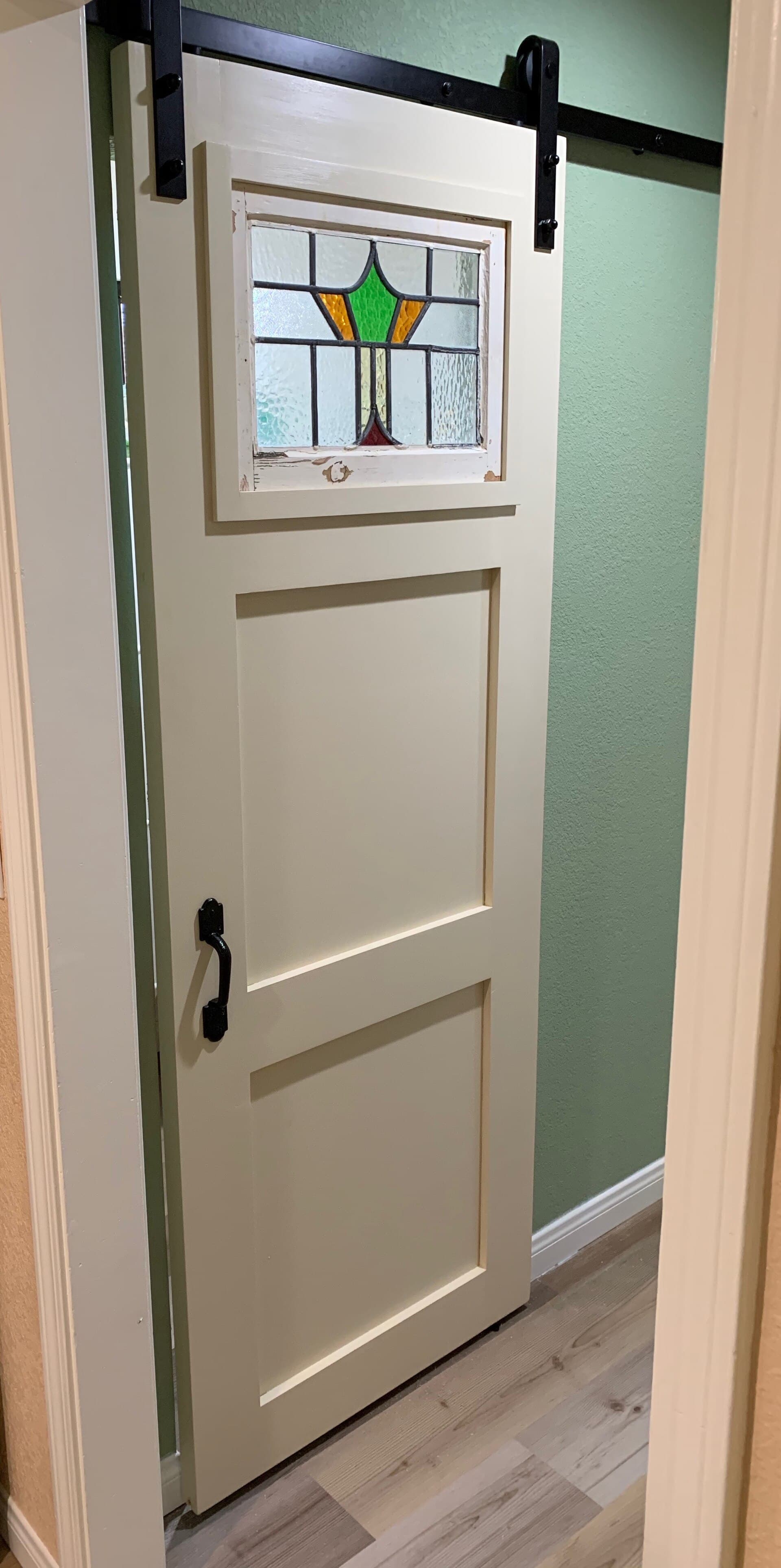
A cavity sliding door — a pocket door, in older language — is the correct answer to a room that cannot afford a swing. It is also a small building project hiding in a wall. Buy it as a wall unit.
Australian houses use cavity sliders where the plan gets tight: a powder room off a hall, an ensuite between two robes, a study that used to be a sleep-out, a pantry that should not slap the fridge. The conflicts are predictable.
If you are still choosing between a swing and a slide, the wider note on internal door sizes, styles and costs is the companion. Here we assume the swing has already lost.
How a pocket actually works
A cavity unit is a thin box that becomes part of the stud wall. The leaf hangs from a track in the head and disappears into the box. A stop or a soft-close catch keeps the door from vanishing forever.
That means the wall is no longer a place you can be casual about.
- The pocket needs a clear width about the same as the leaf, plus the thickness of the unit.
- Noggings, bracing and ordinary studs cannot sit in the leaf’s path.
- Power points and light switches on that stretch of wall have to be thought about before the plaster goes on.
- Insulation in the pocket is a compromise. You cannot stuff a bat in the path of the door.
Standard Australian leaves still rule the order form: 2040 or 2100 high, 720, 770 or 820 wide. A 820 cavity in a 90 millimetre stud wall is a common unit. A 920 accessible leaf needs a bigger pocket. Extra-tall doors need a track that will carry them without sag.
The finished opening is smaller than the leaf width. The leading stile disappears behind a jamb. If you need a particular clear width, say the clear width on the order, not just “820 slider”.
Double cavities and the rooms that want two leaves
A double cavity unit hides two leaves that meet in the middle, or two leaves that stack into opposite walls. Living rooms, wide robes and the opening between a kitchen and a dining room use them.
Two pockets means two walls that cannot take plumbing, two heads that have to stay aligned, and a meeting point that will show every millimetre the slab has moved. In a renovation you are asking two existing walls to become machines.
A double unit is also twice the temptation to put a light switch where the door wants to be. Draw the furniture, the switches and the pockets on the same piece of paper.
Sliders that run on the face of the wall, not into a pocket, are a different product. They save some swing. They do not give you a clean plaster plane.
Plumbing, wet areas and the fights you can avoid
The classic failure is an ensuite cavity that shares a wall with the shower. A mixer body, a cistern, or a set of copper tails does not coexist with a leaf. Something will leak, or the door will hit a pipe, or the plumber will put a hole in the cavity skin and the door will catch on a screw.
Rules of thumb that save marriages:
- Keep pockets off wet-area service walls unless the plumber has already relocated the services.
- In a back-to-back bathroom plan, put the cavity in the bedroom wall, not between two showers.
- Do not run a waste in the bottom plate of a pocket if you can walk it around.
- Exhaust fans and shower steam will still find the pocket. A sealed paint-grade leaf is kinder than an unsealed veneer.
Laundries have the same problem with taps. Pantries have it with a fridge circuit.
If the only wall you have is a service wall, you do not have a cavity slider. You have a hinged door, a surface slider, or a redesign.
Soft-close, latches and the leaf you can still get hold of
Soft-close kits take the last hundred millimetres and slow the leaf. They are worth having in a house with children, or in any opening where a slammed slider will rack the unit. They are another thing in the head, so they need the cassette the manufacturer designed, not a retrofit into a 1990s track that was already tired.
The handle is a design problem people under-specify. When the door is shut you need a flush pull. When it is open you need a way to get it out of the pocket — an edge pull, a dummy, a notch. A beautiful flush pull with no edge pull is how you stand in a bathroom teasing a door with a butter knife.
Latches on cavity sliders are not as simple as a hinged passage set. Privacy snibs exist. They have to work with the jamb kit. A lockable cavity slider on a study is possible; a deadlock is usually the wrong object. If the room is a wet-area powder room, practise the one-handed close with a towel in the other hand before you sign the hardware.
Acoustic seals on a cavity slider are a special order, not a foam tape afterthought. A pocket door will never be as quiet as a well-sealed hinged solid-core door. If the room is a home office that faces a kitchen, you may want the swing more than the floor space.
Accessibility, thresholds and the NCC
A sliding door can help a tight plan and still fail an access brief. The leaf has to open to a clear width the NCC path and AS 1428 require. The handle has to be usable where those rules apply. The threshold has to be low enough.
Internal cavity sliders often have no sill, which is good for a wheelchair and good for a broom. External or wet-area sliders that pick up a track are a different detail. Do not assume “slider” means “step-free”.
The longer access note is NCC access, thresholds and mobility. The buying point is to write the clear opening and the handle height on the drawing, not to rely on a 820 leaf being “probably fine”.
Soft-close should not trap a hand. Specify the kit and then test it slowly.
Structure, lining and the head that must stay straight
The track is only as good as the member it is screwed to. A sagging head is the main reason cavity sliders start to drag after a year. In a load-bearing wall the lintel is doing two jobs: carrying the wall above, and staying straight enough for a rolling door.
Tell the builder this is a cavity unit at framing stage, not at plaster stage. The unit is easier to set plumb when the wall is still a skeleton.
Lining a pocket is usually a thin sheet the manufacturer allows. You cannot hang a heavy mirror or a grab rail on the pocket. You cannot treat that wall as a climbing wall for a toddler, though someone will try.
In a two-storey house, think about sound through the pocket. A thin cavity wall next to a stair can become a drum. Solid-core leaves help a little. They do not invent the mass the wall no longer has.
Costs, lead times and the way these fail
Ranges, in Australian dollars:
- Single cavity unit, 2040 × 820, paint-grade hollow or light solid leaf: about $400 to $1,200 supply.
- Better solid-core leaf, soft-close, 2100 height: about $800 to $1,800.
- Double cavity or a wide pair: about $1,200 to $3,000, and custom runs higher.
- Installation, including setting the unit, lining and hanging: often $400 to $1,200 depending on whether the wall is new.
- Hardware: flush pulls and a privacy kit might be $40 to $200. Better brass or stainless costs more and survives hands better.
These are ranges. A joinery-made timber cavity in a heritage renovation is a different invoice. Lead times are usually a week or three for a standard unit.
Failures I keep seeing:
- A pocket built around an existing pipe “because it almost cleared”.
- A cheap track in a humid bathroom, rollers seized.
- No edge pull, household using a screwdriver.
- A mirror stuck to the pocket, screws in the leaf path.
- A 2040 unit in a 2100 wall with a filler, because nobody measured the finished height.
If you cannot draw the pipes, the switches and the pocket on one elevation, you do not yet have a cavity slider. You have a wish.
A cavity door that works disappears, which is the compliment. Specify the unit early, keep services out of the box, and buy the pulls as if you will use them in the dark. That is the whole of the space-saving trick.
Frequently asked questions
- How much wall do I need for a cavity sliding door?
- Roughly the leaf width plus the frame and a bit of extra pocket. A 820 millimetre door wants about that much clear wall beside the opening, with no wet-area plumbing, no bulk insulation squeeze, and a head that can carry the track. Measure the finished wall run, not the brochure.
- Can I put a cavity slider on a plumbing wall?
- You can if you move the plumbing. A pocket that shares a wall with a shower mixer or a toilet cistern is how renovations go sour. Double-cavity units that hide two leaves need twice the honesty about services.
- Are cavity sliders accessible?
- They can be. You still need the clear opening width, a usable handle, and a threshold that meets the NCC access path and AS 1428 where those rules apply. A sliding leaf is not automatically a better accessible door. The track and the latch matter.
- What do cavity sliders cost in Australia?
- These are ranges. A single unit with a paint-grade leaf is often $400 to $1,500 supply. Soft-close, solid-core, double cavities and custom heights commonly run $1,200 to $3,000 and up. Installation is carpentry and sometimes plaster, not a half-hour hang.
Keep reading

Fire doors for Australian homes and units
A fire door is a tested doorset under AS 1905.1, not a heavier internal leaf. The tag, the closer and the seals are the product.
Marcus Chen · 30 September 2025
Security screen doors that actually work
A security screen is mesh, frame, hinges and a lock that an insurer will recognise. 316 stainless and a diamond grille are not the same product as a flywire door with a key.
Tom Ashford · 19 August 2025
French and bifold doors for Australian living
French pairs and bifolds both open a room to the garden. They ask different things of the weather, the flyscreen and a heritage streetscape.
Priya Nair · 22 July 2025